

Muscle Mass for Cognitive Health
“Exercise is the most effective tool we have for delaying health deterioration and extending lifespan” - Peter Attia
The idea that exercise is one of the most important factors in living a long and healthy life is probably not too much of a surprise to anyone. However, sometimes actionable steps are lacking in these discussions.
My goal for this post is to give actionable steps based on information given in a post written by Dr. Peter Attia about a research study on the benefits of increased muscle mass for cognitive health By the end of this article, you’ll have the framework for a resistance training program that will increase muscle size and provide the cognitive benefits thereof.
Exercise strengthens bones, benefits the cardiovascular system and improves metabolic health - these are things that are pretty commonly talked about. Less commonly talked about is the beneficial effect exercise has on the brain. Most people don’t associate exercise with a healthy brain and better cognitive function. However, they definitely should. It turns out that there’s mounting evidence indicating such an association.
In the aforementioned article on his website, Dr. Peter Attia discusses some of the cognitive benefits that increased muscle mass produces. I recommend reading it for full details, but suffice it to say that more muscle mass is neuroprotective, has a positive effect on cognition, and helps attenuate cognitive decline. The theory is that this might be due to a variety of proteins and peptides (called myokines) that are produced during muscle contraction and elicit a multitude of effects, from reducing systemic inflammation to improving metabolism and mitochondrial function. This inturn has a positive effect on the health of brain cells. So more myokines means better brain health and better cognition. It would therefore stand to reason that having more muscle tissue and contracting that muscle tissue would increase myokine production and therefore cognitive function. The evidence looks pretty good and he references a narrative review that looks at data from over one hundred different studies to draw this conclusion. So if we accept this hypothesis that bigger muscles means a healthier brain, then where do we go from here?
I’m not a doctor nor researcher, but I understand strength training and can put this information into a practical framework.
If we want bigger muscles and more muscle contractions, then training in hypertrophy rep ranges is a good starting point. This is typically in the 8 to 15 range, but can go as low as 6 or as high as 30 depending on the goal. For simplicity, we’ll say that the 8 to 15 rep range is the middle ground and use this.
We’ll also want to think about the number of sets per week for a given muscle group. A general number to shoot for here is 12 sets per muscle group per week for optimal growth. So if we take the quads for example, the sets and rep ranges would look something like this:
4 sets of 12 reps of Bulgarian Split Squats on Monday, 4 sets of 12 reps of Front Foot Elevated Cable Split Squats on Wednesday, and 4 sets of 12 reps of Safety Bar Back Squat on Friday. This would be a rep range and number of sets optimal for stimulating growth and thus providing the benefit of myokines being produced and released into the body to stimulate neurogenesis. Remember, more muscle and more contractions means more myokines and more neurogenesis.
There are other ideas about increases in maximal strength being beneficial via motor unit recruitment and improving cognitive health, but that would be a different discussion about the benefits of increasing strength and its effects on cognitive health. Remember, strength and muscle size are not correlated 1:1 and here we’re just focusing on muscle size.
Below is a sample 3x per week circuit workout that could be done to increase muscle size for cognitive benefit.
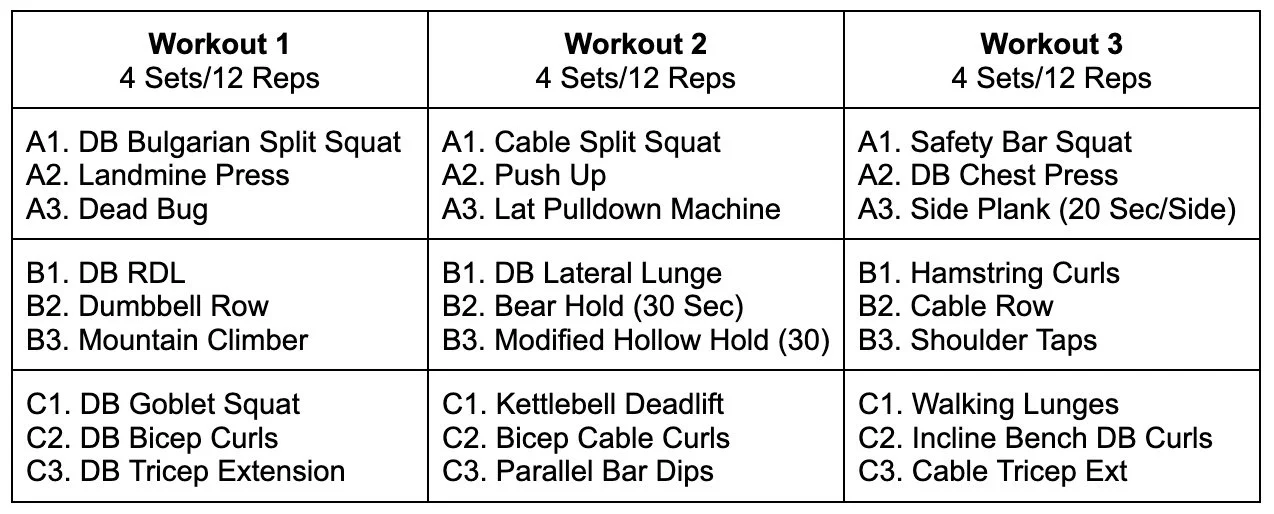
Simple enough to implement and with the circuit format, also quite time efficient. 48 hours rest between workouts is optimal to allow muscle protein synthesis to complete. That means you would do this workout plan as a Mon/Wed/Fri or Tue/Thur/Sat set up.
Now keep in mind that this is a hypertrophy focused workout and doesn’t necessarily include many of the other important aspects of exercise that are beneficial for increasing healthspan and improving longevity. Things like improving Vo2 Max and bone density are best done using other strategies.
If you’re interested in learning more about the Mazama Wellness Comprehensive Longevity Plan, which includes all of these features, click here for more information.
Dustin Millhollen is a Certified Strength and Conditioning Specialist with a Master’s Degree in Nutrition. He is a Personal Trainer and Nutritionist currently based in San Francisco, CA. He offers 1-on-1 in person training in a top-rated gym as well as remote programming for clients all around the world.
If you’d like to book your free consultation, click here.