

How to Create a Simple and Effective Workout Plan.
Let’s look at how to structure an efficient and effective strength training plan. For almost all my client workouts, as well as my own, I use a circuit training structure, which I’ve found to be the best for most people. It offers the widest variety of benefits - things like improved strength and hypertrophy, better cardiorespiratory and metabolic fitness, and increased anaerobic capacity. I’ve also found in my years of training clients that most people find it enjoyable because of the nice variety of exercises that you move through. So let’s talk about what this looks like.
Workout Template:
A typical circuit training workout will be 3 circuits of 3 exercises. Each circuit will have 3 rounds - so this means a total of 9 different exercises for the workout. Each exercise in a circuit will work different muscle groups which allows the exercises to be performed consecutively without overworking a given muscle group.

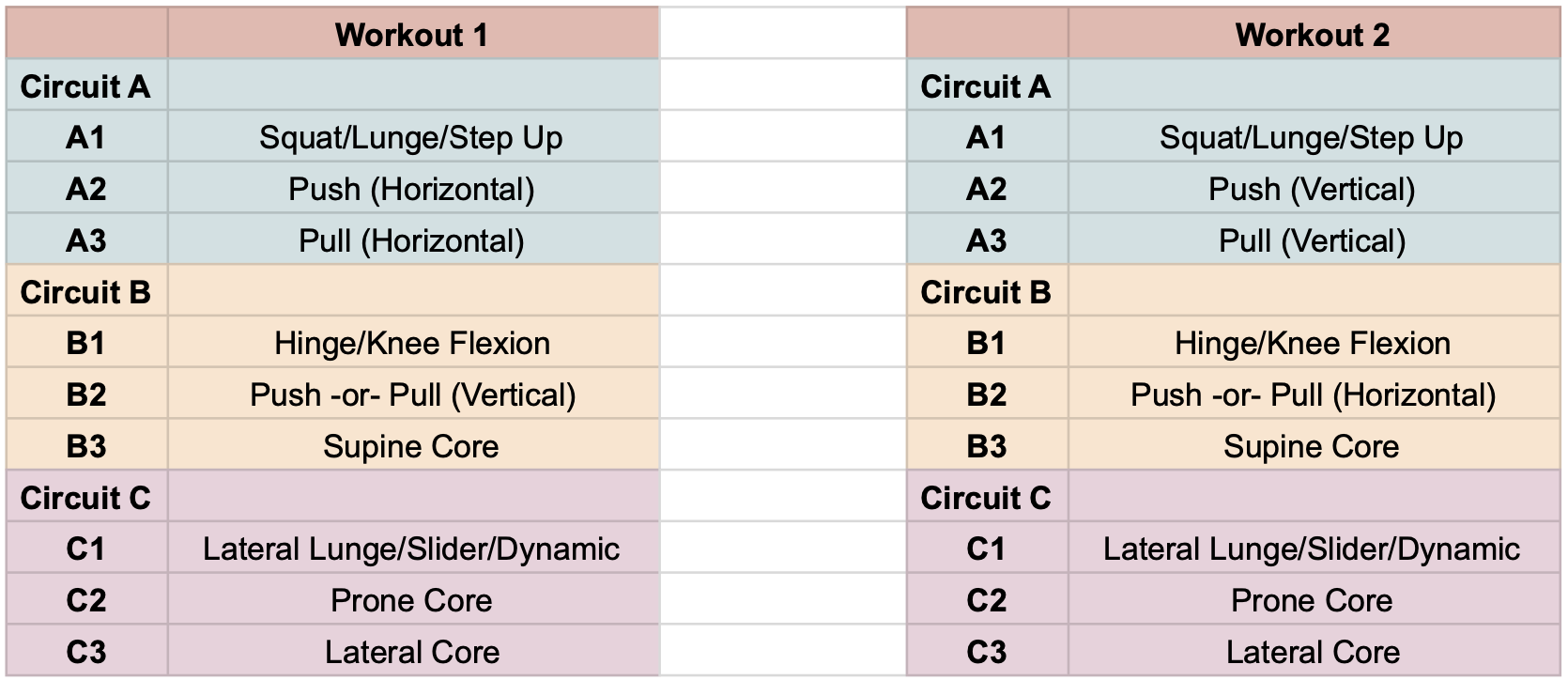
If we look at the Workout 1 template, you’ll see that the first circuit is comprised of a squat, lunge, or step up - so working primarily quads and glutes, a horizontal push - so working chest, shoulders, and triceps, and a horizontal pull - so working the lats, biceps, and other back muscles. The second circuit is comprised of a hinge or knee flexion movement - so working the hamstrings and glutes, a vertical push or pull - so working the shoulders and triceps or lats and biceps depending on whether its a push or pull, and the last exercise is supine core work - so maybe a hollow hold or dead bug working the abs. The last circuit consists of a lateral movement like a lateral lunge or a dynamic movement like a ball slam. Lateral movements are important to work frontal plane movement patterns and dynamic movements are good for athleticism. You also have some prone and lateral core work to finish off the circuit, which work the other abdominal muscle groups. Also, you’ll notice if you look at Workout 2 for that week, the push and pull exercises switch to vertical so you’re getting some of each for the week. This workout template gives a well rounded strength workout in a succinct amount of time. A workout like this will usually take around 1 hour with 1 minute rests between rounds and circuits. These workouts can always be shortened by taking out a circuit and maybe redistributing an exercise or two to another circuit. So that’s the general workout template.
Weekly Schedule:
As far as a weekly schedule, I recommend strength training 2 or 3 days a week. Since my programs are always full body, working out on Monday and Thursday or Monday, Wednesday, and Friday, will give enough time between workouts for muscle protein synthesis to complete. Here is an example of a two and three day a week schedule.
2 Days/Week
3 Days/Week
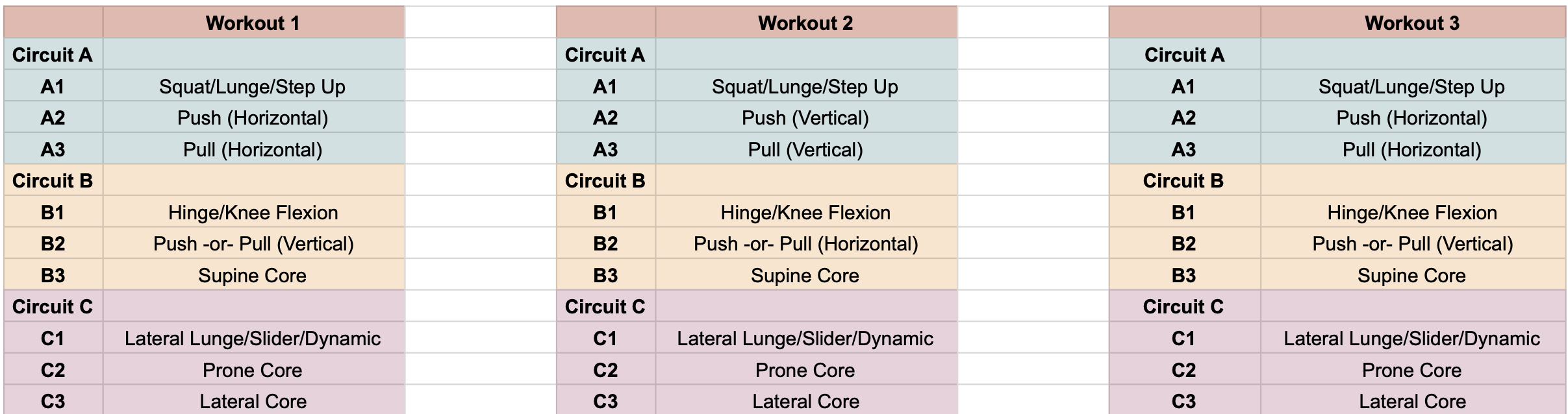
You’ll notice there’s not much difference between the two except that some of the vertical and horizontal forms of exercise are distributed on alternating workouts. Now of course this schedule doesn’t need to be super rigid and sometimes for exercise C1 I’ll just do some front squats or for C3 I’ll do some face pulls. So this should be seen as a general structure to use in order to make sure you’re getting a well rounded program throughout the week, but feel free to add in specific things you want to work on. You can definitely individualize these templates.
Monthly Cycle:
So if we zoom out to what the month looks like, it’ll just be four of the weekly cycles that we’ll go through and then those will change when a new monthly cycle starts. Each week we’ll try to add some weight, reps, range of motion, or slow down the tempo or add pauses. Something to add a challenge. Remember, progressive overload is necessary to improve the benefits of strength training. (Read the progressive overload section of Substack #003 if you haven’t already.) So every week try to add something. It doesn’t have to be every exercise for every workout because that’s probably too much, but at least for 1 or 2 of the exercises of a workout, in order to increase the challenge.
Takeaway:
Circuit training is efficient and effective and in my opinion the best strength training structure for most people for whom fitness and longevity are the goal. If you’re a bodybuilder or powerlifter, you’ll structure your workouts differently, but if you’re someone looking to get stronger, move well, and feel good, then circuit training is the best way to do it. Use the templates above to structure a workout that helps you get the most out of the time you have for training.
TL;DR Video Explanation
If you are looking for The Best Personal Trainer in San Francisco, look no further.
Mazama Wellness provides an all-in-one personal training and nutrition concierge service backed by science and focused on longevity – coached by Dustin Millhollen, a Certified Strength and Conditioning Specialist with a Master’s Degree in Nutrition.